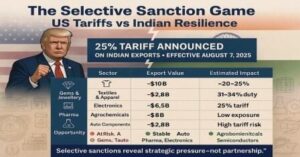
Tariff Uproar in India: India is currently facing a trade setback as the United States has sharply increased tariffs on several Indian exports—raising them to as high as 50%. This sudden escalation in trade duties has sparked nationwide concern, with many industries warning of long-term economic consequences. From seafood to textiles, and pharmaceuticals to auto components, a wide range of Indian products are now less competitive in the global market due to rising U.S. import duties.

The core reason behind this move lies in geopolitics. India’s continued import of Russian crude oil—despite Western sanctions—has drawn strong reactions from the U.S. administration. In what many analysts are calling an indirect diplomatic warning, the new tariffs are intended to pressure India to align more closely with Western trade and foreign policy interests. Tariff Uproar in India
Tariff Uproar in India: Reasons, Benefits, Losses & Impacts
As a result, Indian exporters are grappling with falling orders, shrinking margins, and mounting uncertainty. While some view this as a challenge to India’s global trade standing, others see a hidden opportunity to diversify markets, strengthen domestic industries, and reimagine India’s long-term economic strategy. Tariff Uproar in India
1. What’s Happening and Why the Buzz?
Recently, the United States imposed an additional 25% tariff on Indian exports, effectively doubling the total rate from ~25% to 50%.
This move was triggered by India continuing to import oil from Russia, which the U.S. administration sees as non-cooperation in pressuring Moscow. Tariff Uproar in India
The decision has shaken India’s trade sector, export industry, and global economic relations. Tariff Uproar in India
2. Potential Benefits of Tariffs
- Protection of Domestic Industries: Tariffs limit foreign competition and support local producers and self-reliance.
- Infant Industry Support: Young or fragile industries get time to grow, though this must be temporary and strategic. Tariff Uproar in India
- Encouraging Diversification: This situation can push India to diversify its economy, strengthen domestic demand, and seek alternate markets like the India–UK FTA.
3. Losses and Negative Impacts
3.1 Economic Impact and GDP
- Goldman Sachs estimates India’s GDP could fall by 0.1% to 0.6% due to these tariffs.
- Moody’s and LSEG IBES data suggest mid- to large-cap Indian companies may see earnings decline and overall GDP growth drop by up to 1%. Tariff Uproar in India
- HDFC Bank warns of job losses and reduced investments in labor-intensive sectors like textiles, gems, footwear, etc.
3.2 Impact on Key Industries
- Seafood: India exports ~40% of shrimp to the U.S. This industry faces severe losses. Tariff Uproar in India
- Textiles: Exporters from Tirupur, Noida, and Surat are losing orders and profit margins in the U.S.
- Gems & Jewellery: India exported ₹83,000 crore worth of gems to the U.S. in 2024–25. 50% tariffs are causing severe strain. Production might shift to countries like Dubai or Mexico. Tariff Uproar in India
- Auto Parts: The U.S. is a major consumer (~32%) of Indian auto parts. Profitability and output are under pressure.
- Pharmaceuticals: India is a key supplier of generic medicines. Tariffs will raise prices and reduce U.S. competitiveness. Tariff Uproar in India
- Agri & Dairy: Tariffs on dairy (~38%) and alcohol (~122%) make Indian products more expensive in the U.S.
- Footwear: Footwear exports worth ₹457.66 million face 15.6% tariff hikes, reducing competitiveness.
3.3 Currency & Investment Pressure
- The Indian Rupee hit 88.27 per USD, one of its weakest points, due to weakened exports.
- Over $2.4 billion in foreign capital outflow observed, causing market instability.
- Stock markets saw increased volatility. Analysts warn of short-term hits to India’s growth story, despite long-term optimism. Tariff Uproar in India
4. Who Gains and Who Loses?
| Stakeholders | Gains | Losses |
|---|---|---|
| Domestic Manufacturers | Reduced foreign competition, more protection | Higher raw material cost, increased production cost |
| Workers | Stability in some protected sectors | Job losses and reduced hiring in export-driven industries |
| Exporters | Chance to explore new markets | Cancelled U.S. orders, lower margins, logistic restructuring costs |
| Consumers | More availability of local products | Imported goods (electronics, vehicles, medicines) become expensive |
| Government | Boosts self-reliant image | Reduced customs revenue, strained trade relations |
| Overall Economy | Opportunity to drive domestic reforms | GDP decline, currency pressure, investment outflows |
5. Conclusion: Balanced Assessment
In the short term, the U.S. tariff hike has clearly hurt India’s exports, industries, jobs, currency, and GDP growth.
But in the long term, it could push India to:
- Strengthen self-reliance Tariff Uproar in India
- Diversify export markets
- Undertake strategic policy reforms
It’s important to note that protectionism isn’t always bad — but it must be temporary and well-targeted, with a clear exit strategy.